Conveying systems for coffee
Moving coffee defines how production works
Conveying is often an afterthought in roastery design. In reality, it directly impacts productivity, bean integrity and daily operations. From intake to roasting, storage, grinding and packaging, conveying connects every step of production. Poor systems create downtime, manual handling, dust and bean damage. Well-engineered conveying preserves product integrity, protects operators and keeps coffee moving reliably between processes. At Roastworks, we engineer conveying as a core production system - ensuring efficient flow today while preparing roasteries to scale tomorrow.
Why conveying deserves proper engineering
Production flow and efficiency
Coffee quality protection
Operator environment and safety
Operational reliability
Conveying architectures we offer
Roastworks designs and installs conveying systems that match each roastery's distinct layout and production flow. We tailor our systems to the building, production size, type of coffee, automation goals and plans for growth.
Because there is no universal conveying solution, we remain technology-agnostic. We use a comparative framework to guide early engineering decisions and select the architecture that best fits production reality.
Bucket elevators
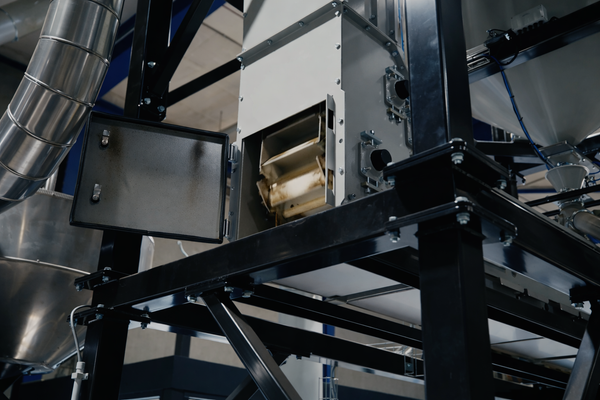
Known for gentle vertical transport with the lowest bean breakage, bucket elevators use Z-shaped routing to also enable long horizontal conveying distances. They are often selected where energy efficiency matters most. Initial investment is typically higher and modularity is limited, but when growth is anticipated, additional intake or discharge points can be integrated later.
Disc conveyors
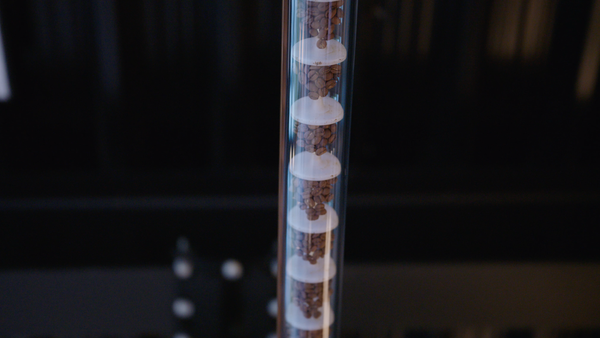
Disc conveyors sit as an intermediate solution between bucket elevators and pneumatic systems, both in routing flexibility and bean breakage performance, while offering strong modularity for future expansion. In open roasteries, they are often appreciated because coffee remains visible while moving through the system.
Pneumatic conveying - Blowing
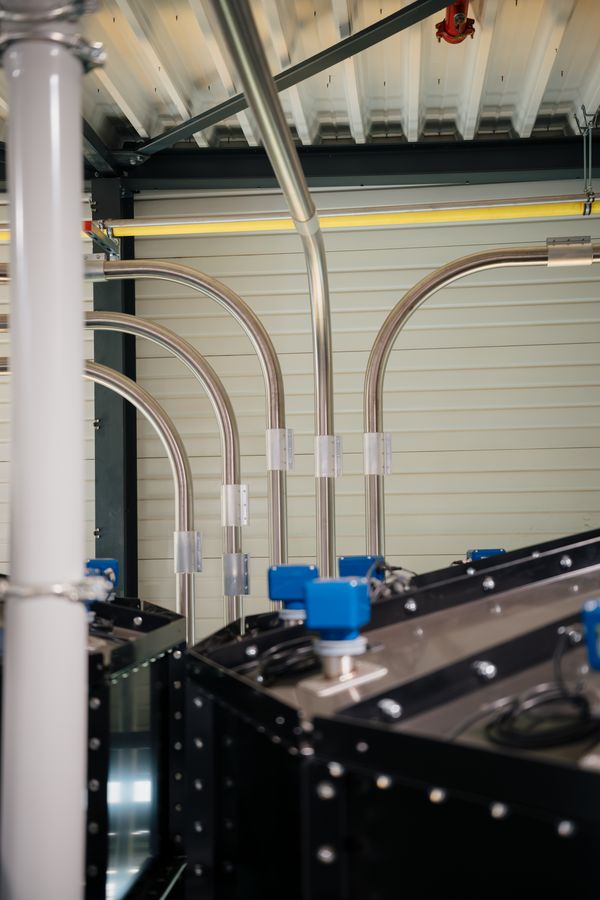
Commonly chosen when noise and energy efficiency are not primary constraints. Blowing systems allow highly flexible routing, easy addition of intake and discharge points and very compact installations. They also typically represent the lowest initial investment.

Pneumatic conveying - Vacuum
Similar to blowing systems in routing flexibility, suction conveying allows coffee to be collected from multiple intake points toward a central destination. Like blowing systems, dust generated during conveying must be recovered at discharge points through cyclones and filtration systems.
Screw conveyors
Used mainly for short horizontal transfers, such as moving coffee across large intake hoppers toward the next conveying system. The main engineering constraint is balancing bean breakage while minimizing product residue.
Belt conveyors
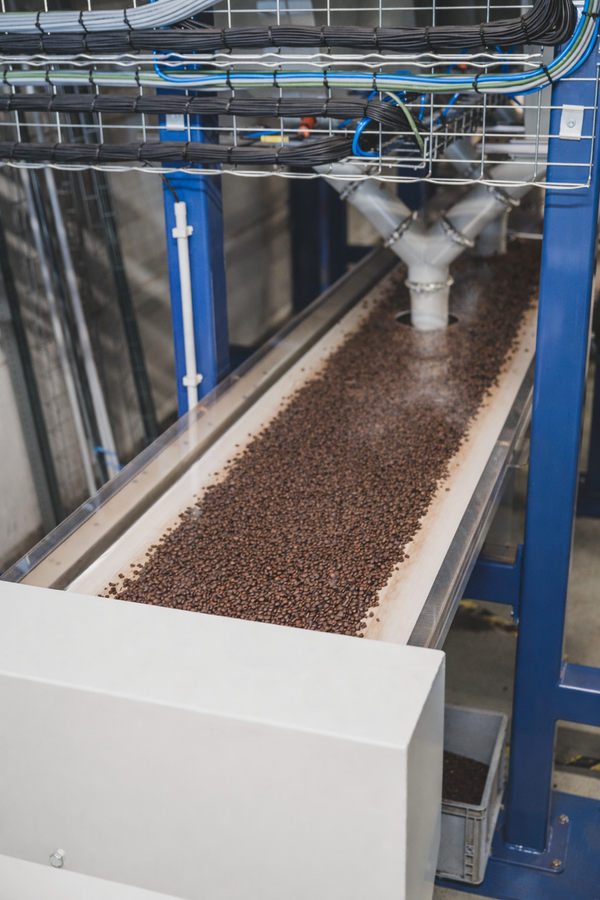
Used for both green and roasted coffee, often in combination with bucket elevators. Belt conveyors provide an economical way of transporting coffee horizontally or at low angle inclination. They are particularly useful when conveying controlled quantities of coffee beneath linear silos.
Green coffee conveying at a glance
| Criterion | Bucket elevator | Disc conveyor | Pneumatic conveyor - blowing | Belt conveyor |
|---|---|---|---|---|
| Vertical conveying | ||||
| Routing flexibility | ||||
| Energy efficiency | ||||
| Noise level | ||||
| Dust management | ||||
| Maintenance simplicity | ||||
| Expansion flexibility | ||||
| Throughput capacity | ||||
| Cleanability | ||||
| Investment cost |
Highlights - Green coffee conveying
Integrated dust control
Dust is generated at intake points for both mechanical and pneumatic conveying systems. In pneumatic conveying, dust is also generated during transport and is therefore collected at discharge points. We integrate local extraction and treat dust through cyclones and filtration systems to reduce exposure and cleaning requirements.
ATEX compliance
We can advise and design conveying solutions with ATEX-compliant options to ensure safe operation in hazardous or combustible environments.
Avoiding cross-contamination
Our conveying systems are engineered to prevent cross-contamination between coffees, ensuring no residue or remaining beans stay in the system between production runs.
Highlights - Roasted coffee conveying
Bean integrity protection
Roasted coffee is fragile and sensitive to impacts and abrupt transfers. Our conveying systems minimize mechanical stress to reduce broken beans and fines. This preserves product appearance and quality through downstream operations.
Automation, weighing & system integration - Engineered together
A roastery performs best when all processes operate as one coordinated system. Conveying must interact with storage, roasting and downstream operations rather than function in isolation. At minimum, sensors prevent overfilling and stabilize product flow. With integrated weighing and production software, the system automatically conveys the right coffee, in the right quantity, exactly when the next machine requires it - reducing manual intervention and stabilizing production flow.
Modularity & scalability - Planned, not oversized
Roasteries often operate with ambitious growth plans. Doubling production within a few years - and sometimes growing much faster - is common, especially among specialty coffee roasteries. This means designing modular conveying layouts, anticipating future machines and preparing routing so new equipment can be integrated without costly retrofits. That is where good engineering matters. Together, we build a predictable roadmap for expansion so growth can happen without premature investment. The goal is simple: control CAPEX today while preserving flexibility tomorrow.
Engineering approach - Designing intake systems that work
A conveying system performs best when engineered as part of the complete production flow from intake to roasting, storage, blending, grinding and packaging.
Our engineering approach begins by understanding:
- Building geometry and structural constraints, including possibilities such as ground-level intake hoppers
- Fire safety, ATEX requirements and dust treatment strategies
- Interfaces between intake, storage, roasting, blending, grinding and packaging equipment
- Current production volumes and expected growth
Depending on the project, we either translate a defined specification into a robust design - or help shape the specification before key decisions are locked in.
From there, we engineer:
- Conveying architecture and routing adapted to plant layout
- Flexible bypass solutions allowing coffees to be easily integrated or removed from production flow
- Integration with roasting, blending, grinding, and packaging operations
- Gentle product handling across all conveying stages
- Upstream and downstream conveying interfaces
- A realistic expansion roadmap designed for future phases
Questions? We're here to assist.
The right choice depends on layout constraints, acceptable bean breakage, energy consumption targets, dust management strategy and future expansion plans. Mechanical systems are typically more energy efficient and gentle, while pneumatic systems offer greater routing flexibility in constrained buildings.
Breakage is controlled through conveying speed, routing design, drop heights and transfer points. Gentle routing, controlled velocities and minimizing impacts allow breakage to stay very low - especially important for roasted coffee and high-quality whole bean products.
Yes, if designed correctly from the start. Conveying routes, pickup points and discharge points can be planned so new machines, silos or packaging lines can be connected later without costly redesigns or production interruptions.
Need help choosing the right conveying solutions?
Every roastery and growth plan is different. Talk with us and design your optimal conveying architecture.