Growing industrial roasteries
You’re already operating at serious volume and performance is measured in stability, reliability and repeatability. Your challenge isn’t whether the roastery can run, it’s whether it runs as one coherent system. As complexity increases, bottlenecks, inefficiencies and integration gaps become costly and automation and compliance move from “projects” to daily operational needs. You’re looking for a partner who can take system-level responsibility and help your factory stay scalable, upgradeable and under control over the long term.
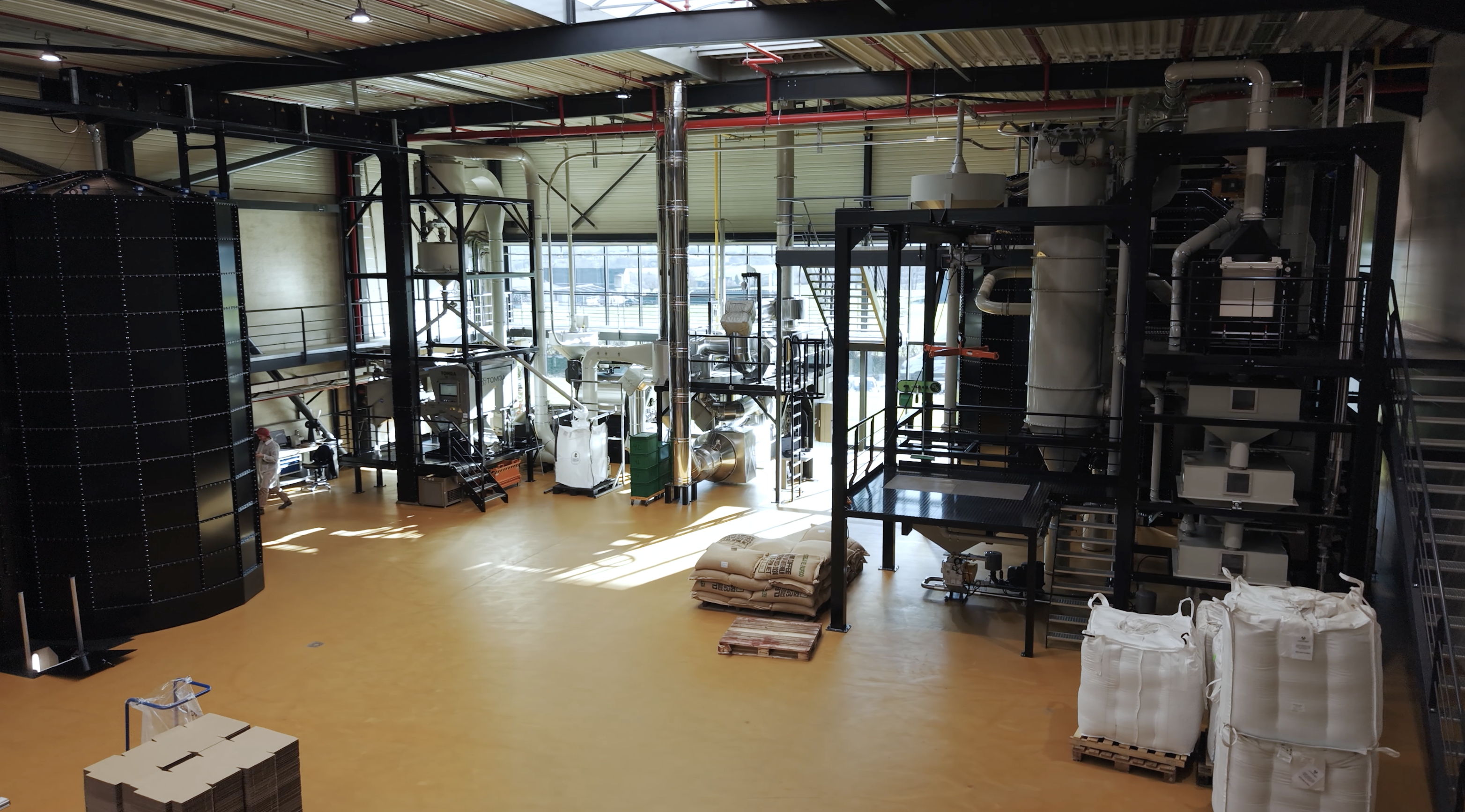
Signs your roastery is entering a new phase
Industrial roasteries often grow through increasing contract volumes, new product lines or additional production sites. At a certain point, operational complexity begins to outgrow the existing production structure.
Typical signs include:
- Production lines operating close to maximum throughput
- Manual coordination between roasting, grinding and packaging
- Difficulty maintaining consistent quality across shifts
- Production planning becoming dependent on individual operator experience
- Adding new clients creates operational pressure
Understand your operational reality
Scaling faster than your engineering capacity
Roasteries often grow faster than their internal operations and engineering teams can expand. Production demands increase, but system planning, integration and optimisation struggle to keep pace. Complexity rises before the organisation has the structure to absorb it.
Bottlenecks show up in handling, storage and packaging
At volume, constraints rarely come from roasting alone - they emerge in movement, buffering, dosing and end-of-line operations. Storage and conveying become critical and packaging performance defines throughput. The factory begins to behave like a chain where one weak link limits everything.
Automation, compliance and traceability are becoming unavoidable
As production scales, automation shifts from improvement project to operational necessity. Compliance requirements around dust, emissions, food safety and traceability become central design drivers.
Downtime and manual workarounds become expensive
Manual interventions that were manageable at smaller scale become costly in multi-shift operations. Downtime impacts margins, delivery schedules and operator load. There is a huge need for a coherent operating system that reduces friction across the roastery.
How we approach industrial growth
Roastworks approaches industrial roasting environments as complete production systems. Instead of focusing on individual machines, we design how roasting, grinding, storage, packaging and logistics interact as a coordinated production environment.
Our approach focuses on:
- Plant-level material flow design
- Integration of existing and new equipment
- Automation and control architecture
- Operational stability across shifts and product lines
- Long-term scalability of the production system
The goal is to transform a collection of machines into a reliable production backbone for the factory.
Hear from our customers
Lorem ipsum dolor sit amet, consectetur adipiscing elit, sed do eiusmod tempor incididunt ut labore et dolore magna aliqua.
Arno Welkenhuysen, Production Manager at Oke Koffie, Oke Koffie
Building reliability into daily production.
Pascal Herzog, COO at Vicafé, ViCafé
A roastery that grows with the business
Benoit Liégeois, CEO at Charles Liégeois , Charles Liégeois
A partnership built on shared expertise